


新闻中心
News Center
How a Variable Spacing Handling System Fits a Mixed Warehouse
Publish Time:
2026-11-12
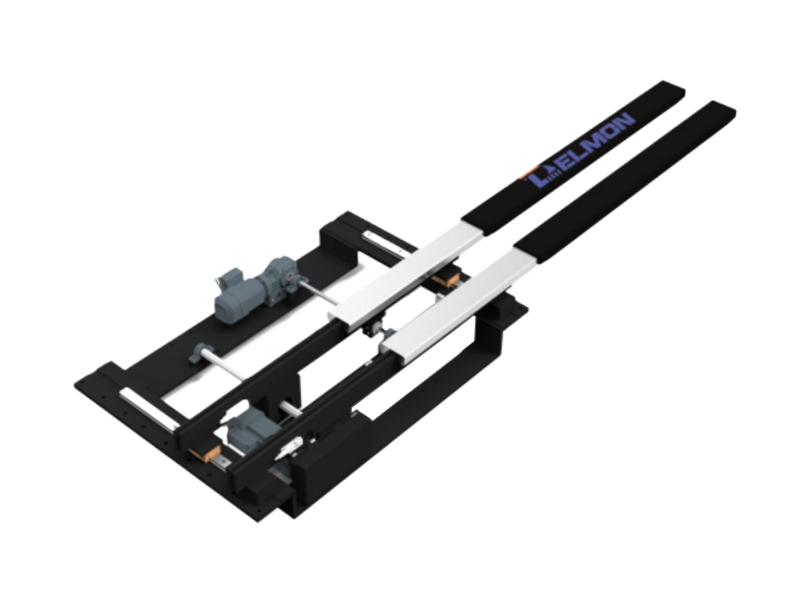
A variable spacing handling system is a load-handling device whose fork or cradle can change its spacing to suit different carrier sizes. The Delmeng Lingju Flex is described on the page as a fully electric variable-distance system that breaks the fixed wheelbase of a traditional forklift and switches quickly between carriers of different sizes. It is listed in the cradle hold category and is aimed at multi-category warehousing and automated storage and retrieval systems. For a warehouse that handles several pallet or container formats, that flexibility is the reason to look at the product.
The Fixed Spacing Problem
A conventional forklift or a fixed fork has a set distance between its tines or its cradles. That distance is chosen for one carrier format, and a different format needs a different attachment or a manual adjustment. The page describes the Lingju Flex as a break from that limit, using a fully electric variable-spacing technology to change the spacing without a manual rebuild. In a warehouse with mixed formats, the changeover time is the hidden cost, and a system that adjusts itself removes that cost from the cycle.
The page presents the change as a quick switch between different sized carriers, not as a one-off adjustment. That wording points to a system that can move from one format to another during a shift, which is what a multi-category warehouse needs. The buyer should confirm the range of spacing, the carrier sizes it covers and the time it takes to change, because those three figures decide whether the system fits the actual mix. A wide range with a slow change may be less useful than a narrower range that changes in seconds.
Where It Is Used
The page names automated storage and retrieval systems and other intelligent warehousing fields. In an AS/RS, the handling device moves a carrier between the rack and the conveyor, and the spacing has to match the carrier every time. A variable-spacing system can serve several carrier types with one device, which reduces the number of dedicated machines in the aisle. The page places the product in the cradle hold category, so the handling action is a cradle rather than a pair of forks.
The same idea applies to a conventional warehouse that is moving toward automation. A fixed fleet of forklifts with different attachments can be replaced by a smaller number of flexible units, provided the throughput and the load are within the system's capacity. The buyer should map the current carrier types, the weights, the rack heights and the cycle times before the order. The page does not list a load rating for this model, so the capacity should be confirmed with the supplier against the actual pallet.

Efficiency and Design
The page gives two headline figures: equipment energy consumption reduced by 30 percent and throughput increased by more than 50 percent. Those figures should be checked against the baseline used in the comparison, because the result depends on the layout, the load and the number of moves. What the page makes clear is the design intent: electric spacing removes a manual step, and a shorter changeover raises the number of moves per shift. A site trial or a simulation is the best way to confirm the gain.
The system is described as modular, with rapid expansion, and as built to an industrial-grade standard. A modular design lets a warehouse add a unit or a section without replacing the whole system, and it makes a spare part easier to hold. The page also describes a full-process digitalisation with AI predictive maintenance. That means the system can report its condition and flag a part before it fails, which matters in an automated aisle where an unplanned stop blocks the whole line.
Ordering the System
Before ordering, the buyer should send the carrier types and sizes, the load per carrier, the rack and aisle layout, the required throughput and the interface with the warehouse control system. It also helps to send a drawing of the carrier and a video of the current handling cycle, so the supplier can propose the spacing range and the cradle design. The page gives an international phone number and two email contacts, and the quotation should list the unit, the control, the integration and the commissioning.
Delmeng is described as a high-tech enterprise focused on the research, development, design, manufacturing and sales of intelligent logistics equipment, with telescopic forklifts as its core product. The Lingju Flex sits alongside the PanShi and Trailblazer ranges on the site. For a buyer, the practical step is to compare the spacing range, the load and the changeover time with the warehouse mix, then test the system on the actual carriers before a full order is placed.


Contact Information:
13399555771 (International) / 4006786168(Domestic)
Email:
Nanjing Delmeng Technology Co., Ltd. is a high-tech enterprise focusing on the research and development, design, manufacturing, and sales of intelligent logistics equipment. The company's core product is telescopic forklifts, which are widely used in automated storage and retrieval systems (AS/RS) and other intelligent warehousing fields.
Online Message
If you are interested in us or our products, please feel free to leave us a message.